1
Ideate & Build
Business Innovator
vibe.powerapps.com
- Describe the idea in natural language
- AI builds the first working app
- Validate with real users in days
- Hand off — or keep going
Build with AI speed. Govern with enterprise confidence.
Secure Vibe Coding with Microsoft Dataverse — a conversational walkthrough of the same argument made on this page. Pop it on during your commute, then come back for the diagrams.
Heads up: ~35 MB file — give it a few seconds to buffer after pressing play.
Business Innovators start in vibe.powerapps.com — describe an idea, ship a working app. Pro Developers ship in VS Code with an approved AI coding assistant and full CI/CD. In between sits the persona that breaks the old ceiling: the Innovative Maker, who fluidly moves between vibe.powerapps.com and VS Code — given incredible AI superpowers, but contained and controlled by the platform.
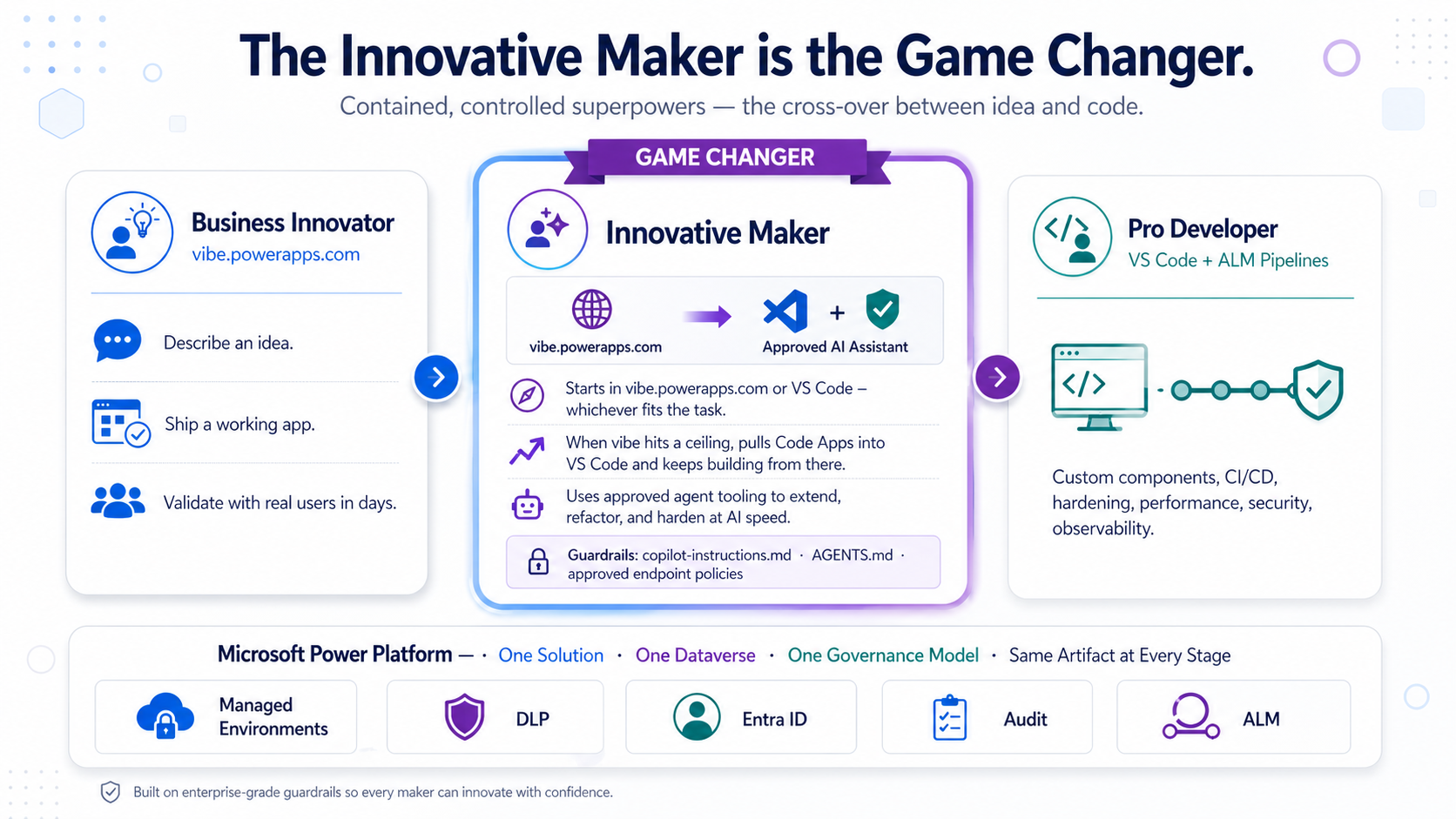
copilot-instructions.md and AGENTS.mdThese are roles, not necessarily different people. Often a Business Innovator becomes the Innovative Maker the moment vibe hits its limit — and the platform makes that step continuous instead of a cliff. The Pro Developer joins when CI/CD, custom components, or hardening matter. Same solution, same Dataverse, same governance throughout — that's what makes the cross-over safe.
Admins configure ALM pipelines and Managed Environments once. After that, makers ship to dev → test → prod with proper promotion, DLP, and approval gates baked in.
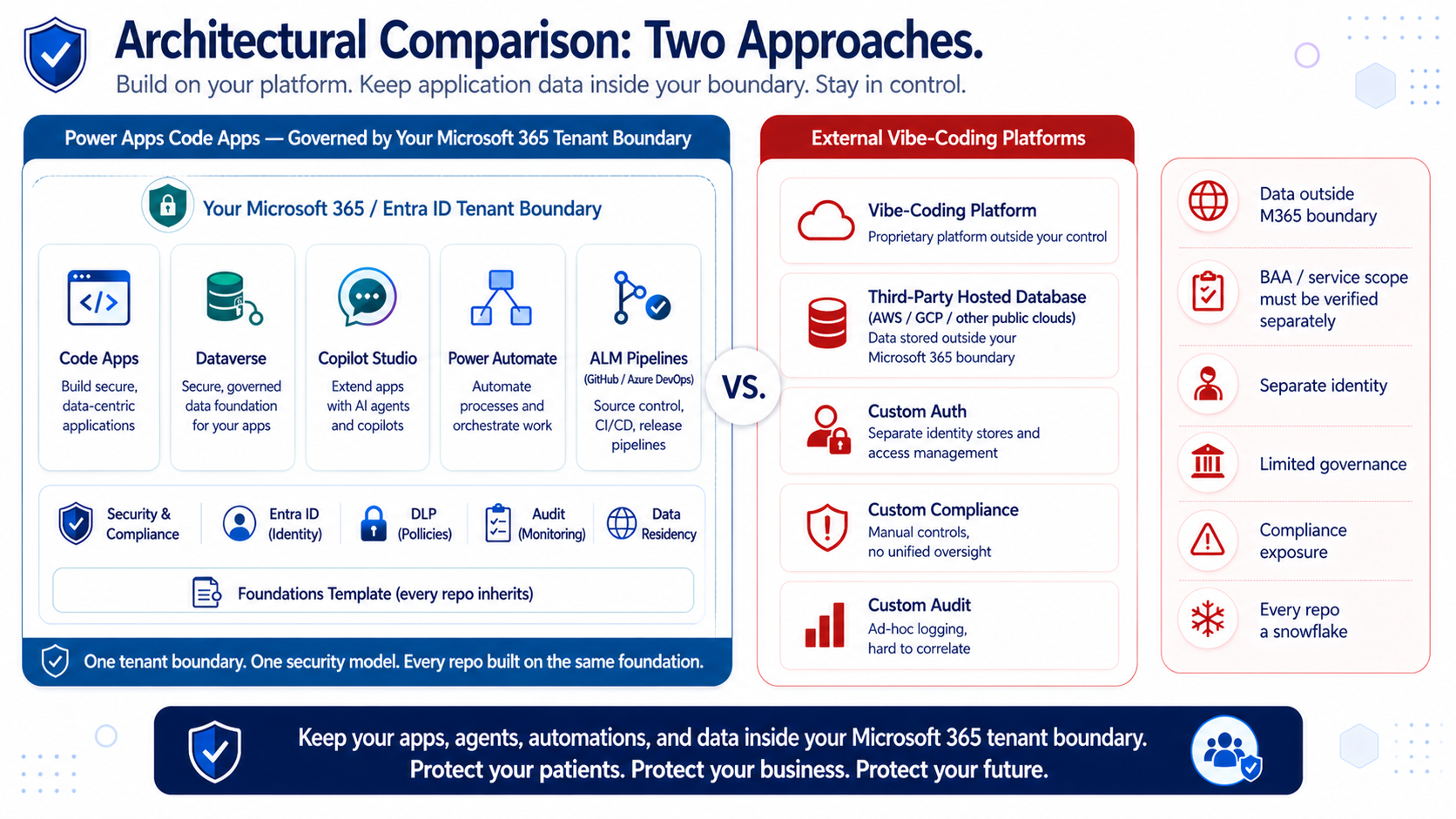
The problem isn't repo count — Code Apps create plenty of repos too. The problem is repos that don't inherit a common foundation.
For any organization handling PHI, this single chapter changes the conversation. It's a contractual and regulatory boundary — not a preference.
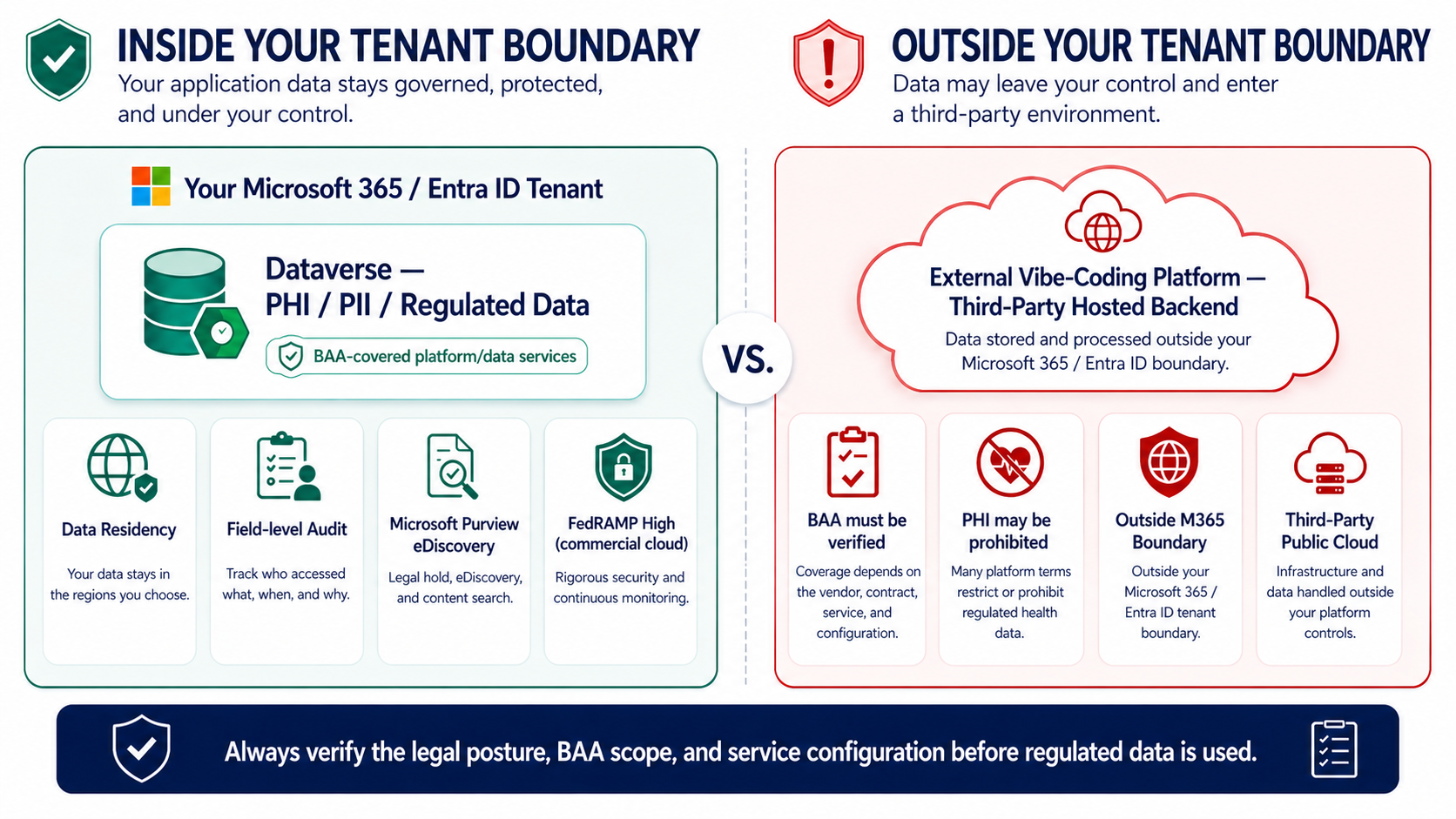
This boundary describes the application platform and data layer. Coding assistants are selected separately: teams handling regulated data should route prompts only through AI services their legal and security teams have approved for that workload.
This pattern is common across the category. We use Lovable here as a representative example because their terms are particularly explicit. Replit, Bolt, v0, and similar platforms typically carry comparable restrictions in their own published terms — always verify the current legal documents of any platform you evaluate.
Terms & Conditions lovable.dev/terms"You agree not to upload, input, or otherwise provide any protected health information under HIPAA, or any other sensitive categories of data… Our Services are not designed to handle that type of data, and we disclaim all responsibility if you choose to submit it."
Data Processing Agreement · §8 lovable.dev/data-processing-agreement"The Customer shall not provide any data to Lovable which is classified as sensitive. For the avoidance of doubt, the Customer agrees not to upload… any protected health information under HIPAA…"
Privacy Policy lovable.dev/privacyExplicitly warns against uploading sensitive health data.
Microsoft signs a BAA and keeps your data inside your Microsoft 365 tenant boundary. The external vibe-coding category, broadly, does not — and many of these platforms explicitly prohibit PHI in their own published terms. Always confirm the legal posture of any platform before letting regulated data near it.
In the era of intelligent agents, the data layer must speak the agent's language. Many databases now ship MCP servers — including Azure SQL, Cosmos DB, and Postgres — but they expose schema. Dataverse's MCP exposes business semantics: security roles, business units, business rules, choice sets, relationships, and audit — the things agents actually need to act safely on enterprise data.
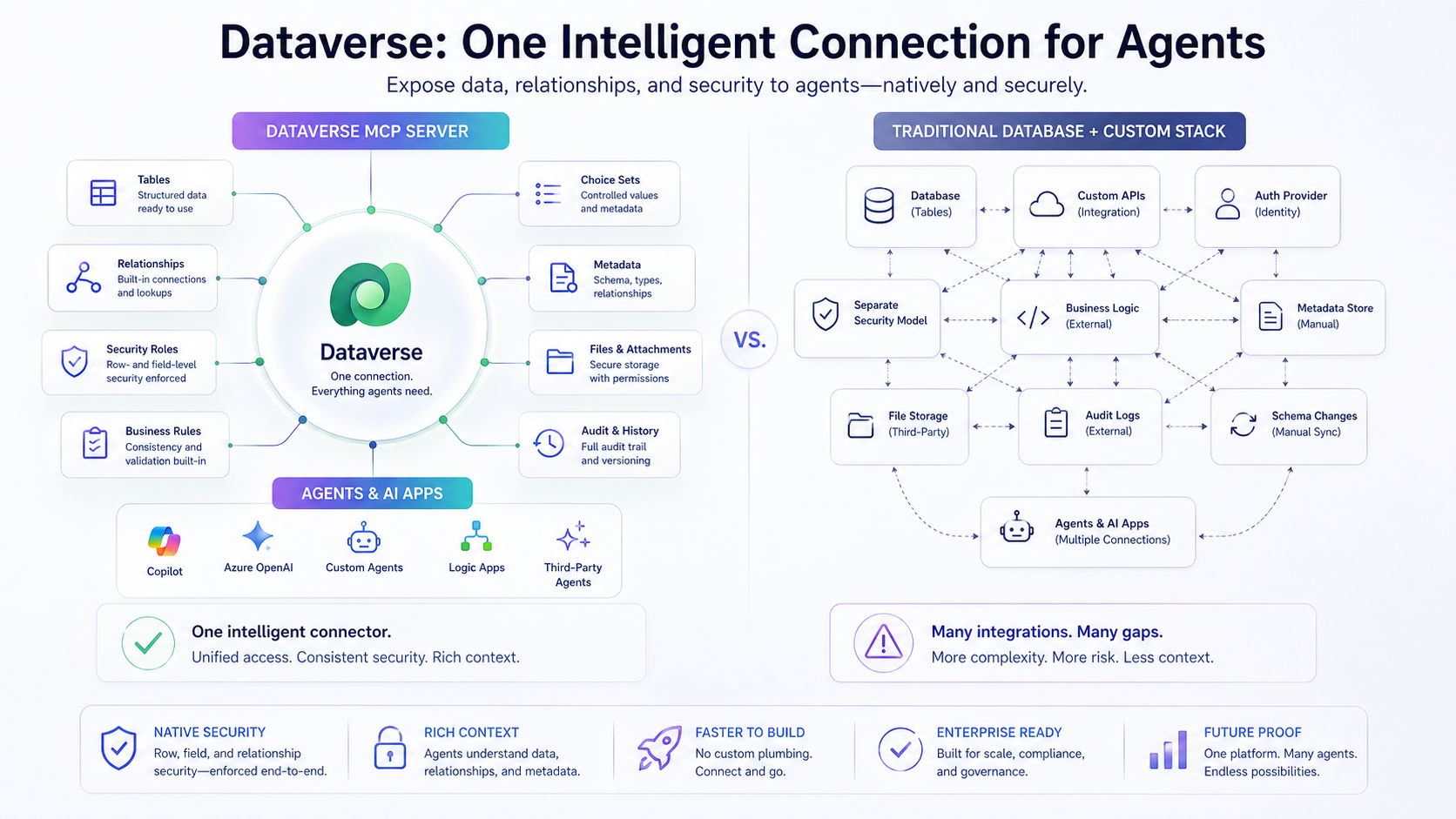
Different audiences. Same data. Same governance. One trusted platform.
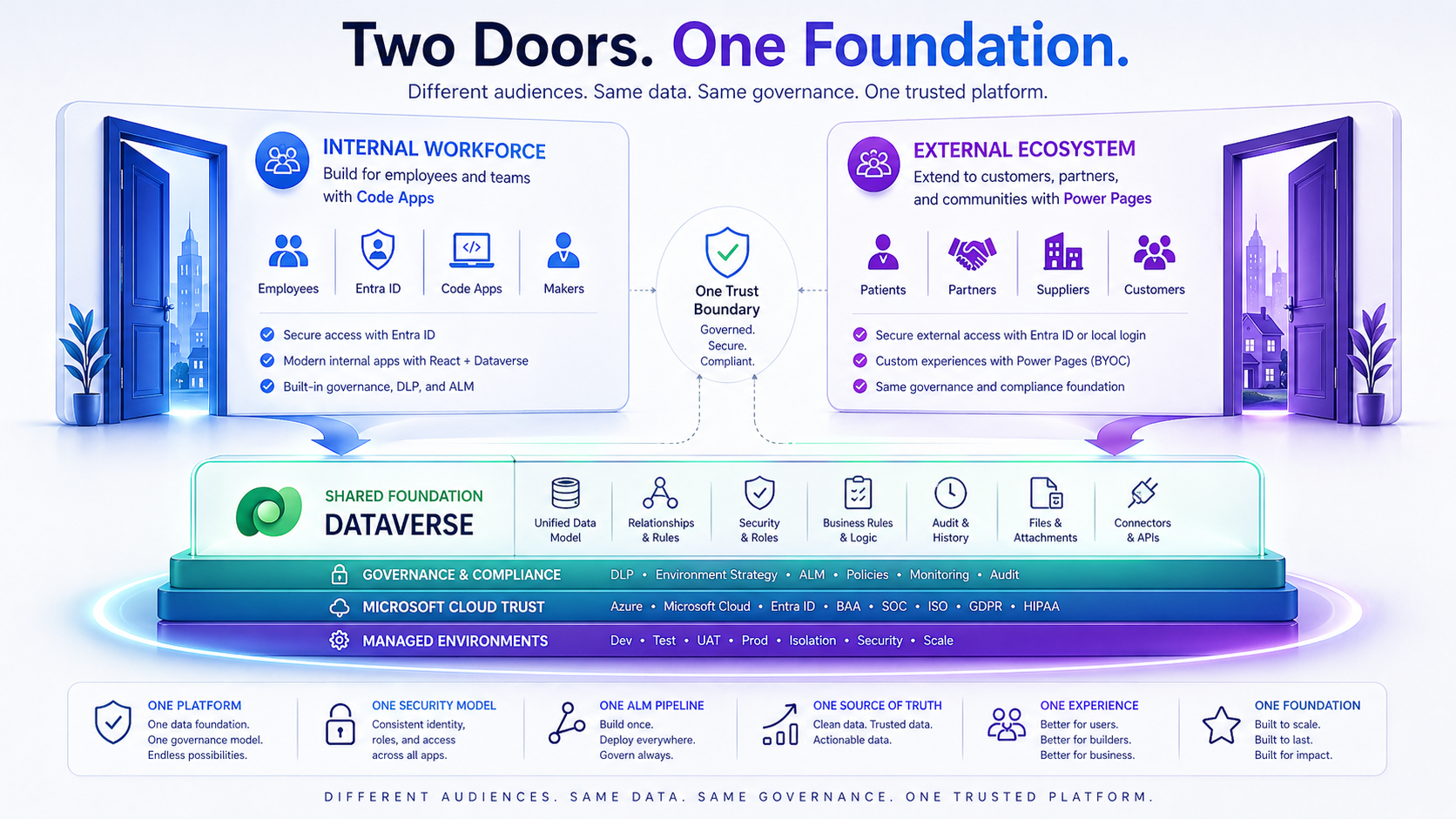
Dataverse is a governed business application platform. The difference shows up in nearly every dimension that matters at enterprise scale.
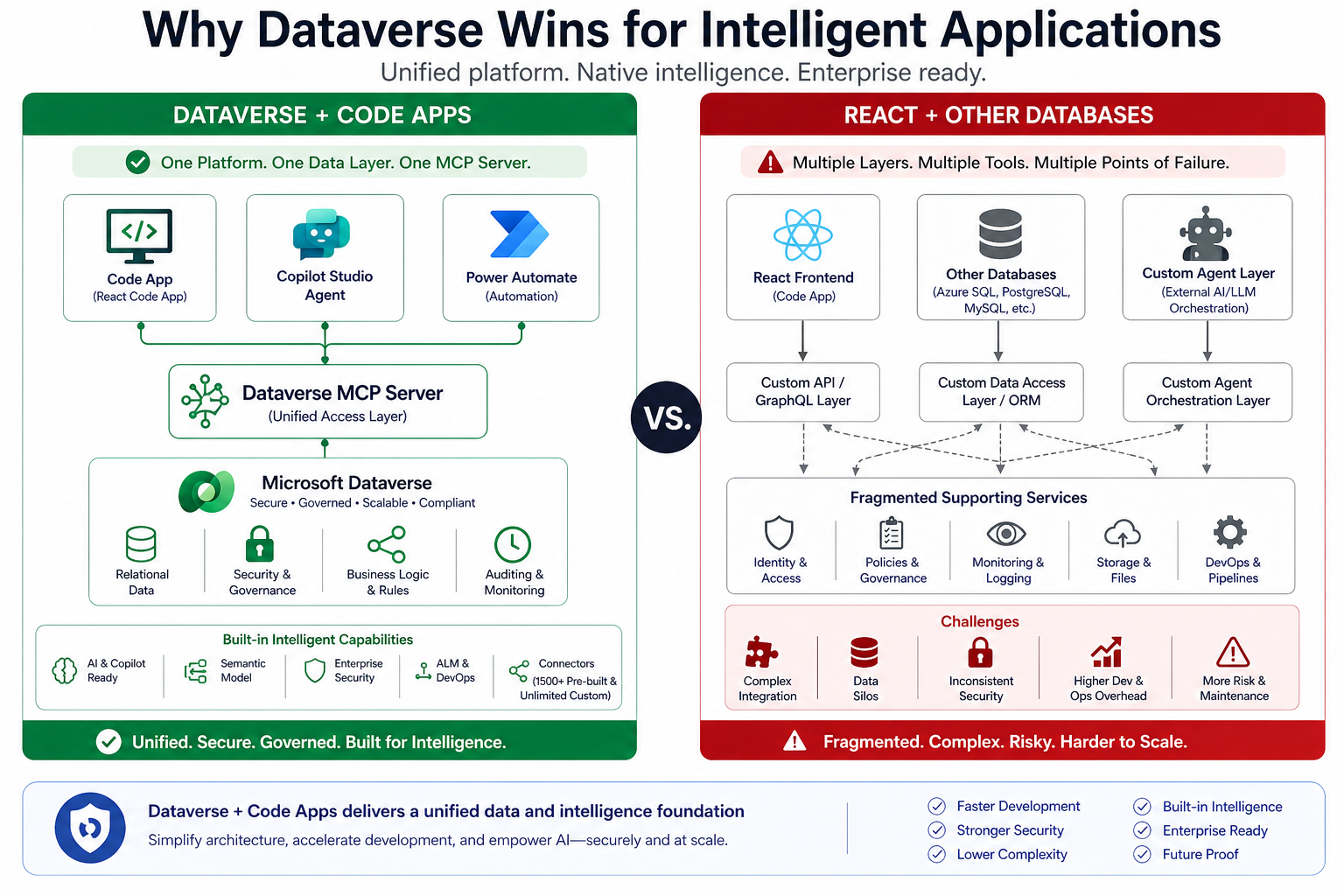
Simplicity drives value. Complexity drives cost, risk, and time.
We deliberately don't put dollar signs here — pricing varies by scale, region, and deal. The point is the shape of the cost structure.
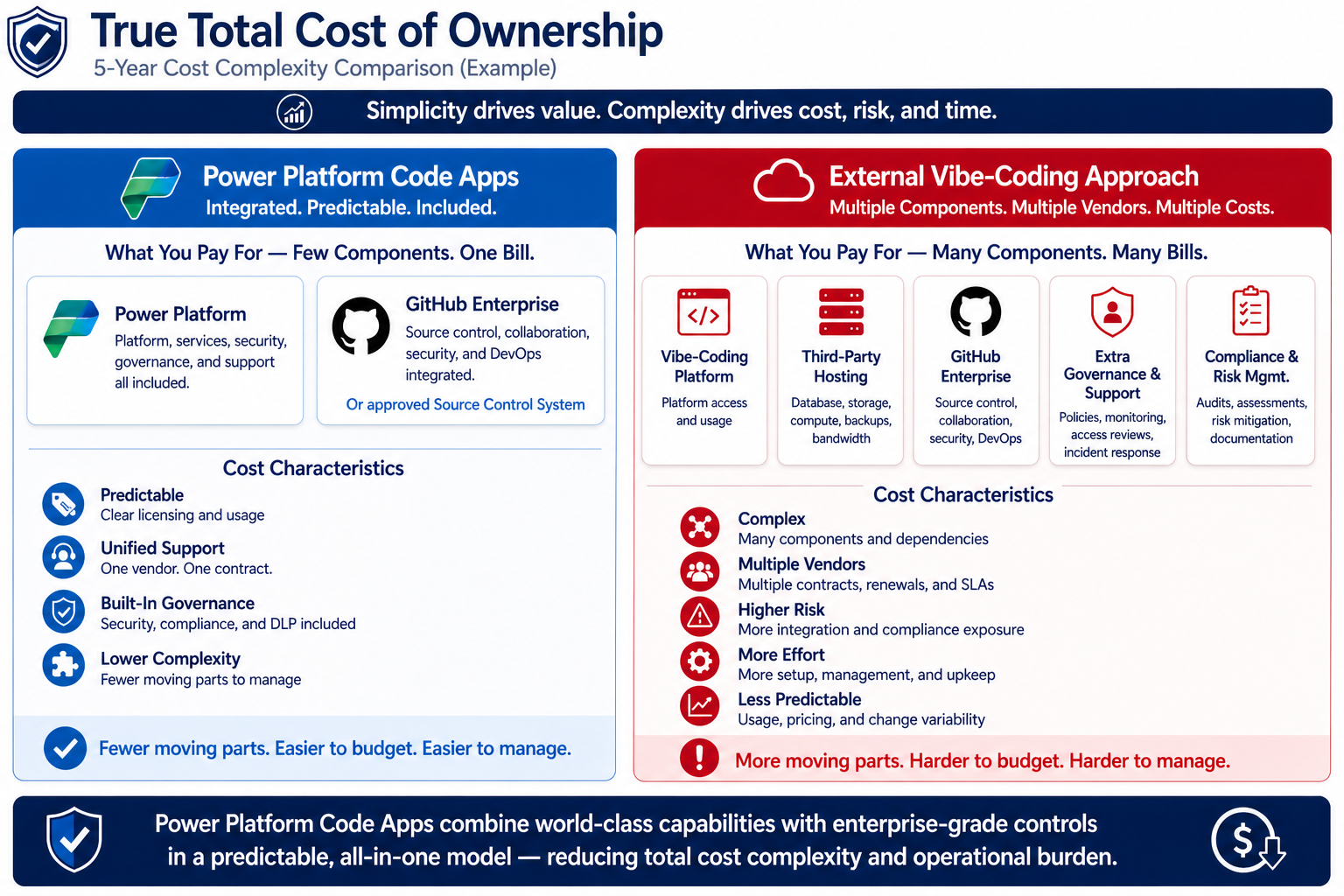
What you pay for: Few components. One bill.
What you pay for: Many components. Many bills.
One platform. Fewer moving parts. Greater value.
Coding-model leadership shifts month to month. The VS Code ecosystem lets developers use the assistant route their organization approves — GitHub Copilot, Claude Code, Codex, Cursor, Cline, or direct API integrations — while still building the same governed Code App on Dataverse. The point is not one assistant. It is transparent routing, named models, and a platform foundation that remains consistent as the AI layer changes.
Below: a cross-section of leading coding models and assistant surfaces available across the VS Code ecosystem in 2026. Availability, contractual coverage, and data-handling posture vary by route; regulated teams should validate the approved path with legal, security, and procurement.
Industry-leading agentic coding & long-horizon refactors.
Strong general coding & deep reasoning workflows.
Massive context windows for whole-repo reasoning.
A productive default for many workloads; confirm fit for regulated data-handling scenarios.
IDE-native agent loops, model of your choice.
Real-time web context for current API knowledge.
Strong code completion at lower cost-per-token.
Self-hostable for sovereign workloads.
A strong default for many developer workflows. Treat it as one approved option, not the only AI path.
For Claude-based agent work, route the CLI or VS Code extension to an approved Foundry-hosted endpoint where available.
For OpenAI coding agents, route through your Azure OpenAI resource using Entra ID or managed keys under your Azure controls.
The practical pattern is simple: keep the application, data model, ALM, and governance in Code Apps + Dataverse, then let legal and security approve which AI assistant endpoint can receive prompts for each workload. For PHI-adjacent scenarios, confirm the applicable BAA and service scope in writing before enabling that route.
copilot-instructions.md sets guardrails across every assistant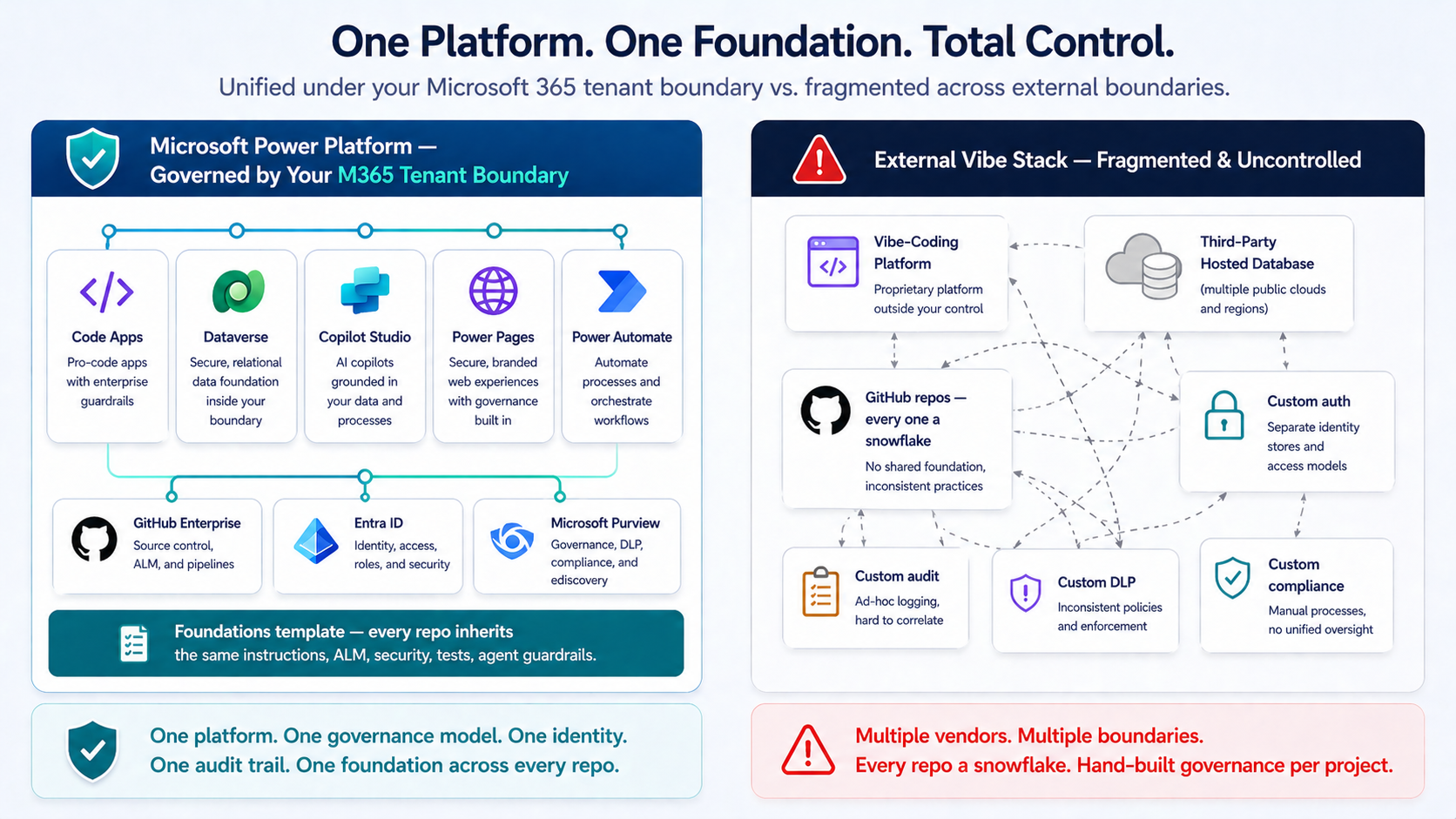
Most teams spend their first month discovering platform quirks the hard way. PAppsCAFoundations encodes every one of those lessons into a repeatable, tested path — so your team builds features on day one, not debugs platform quirks.
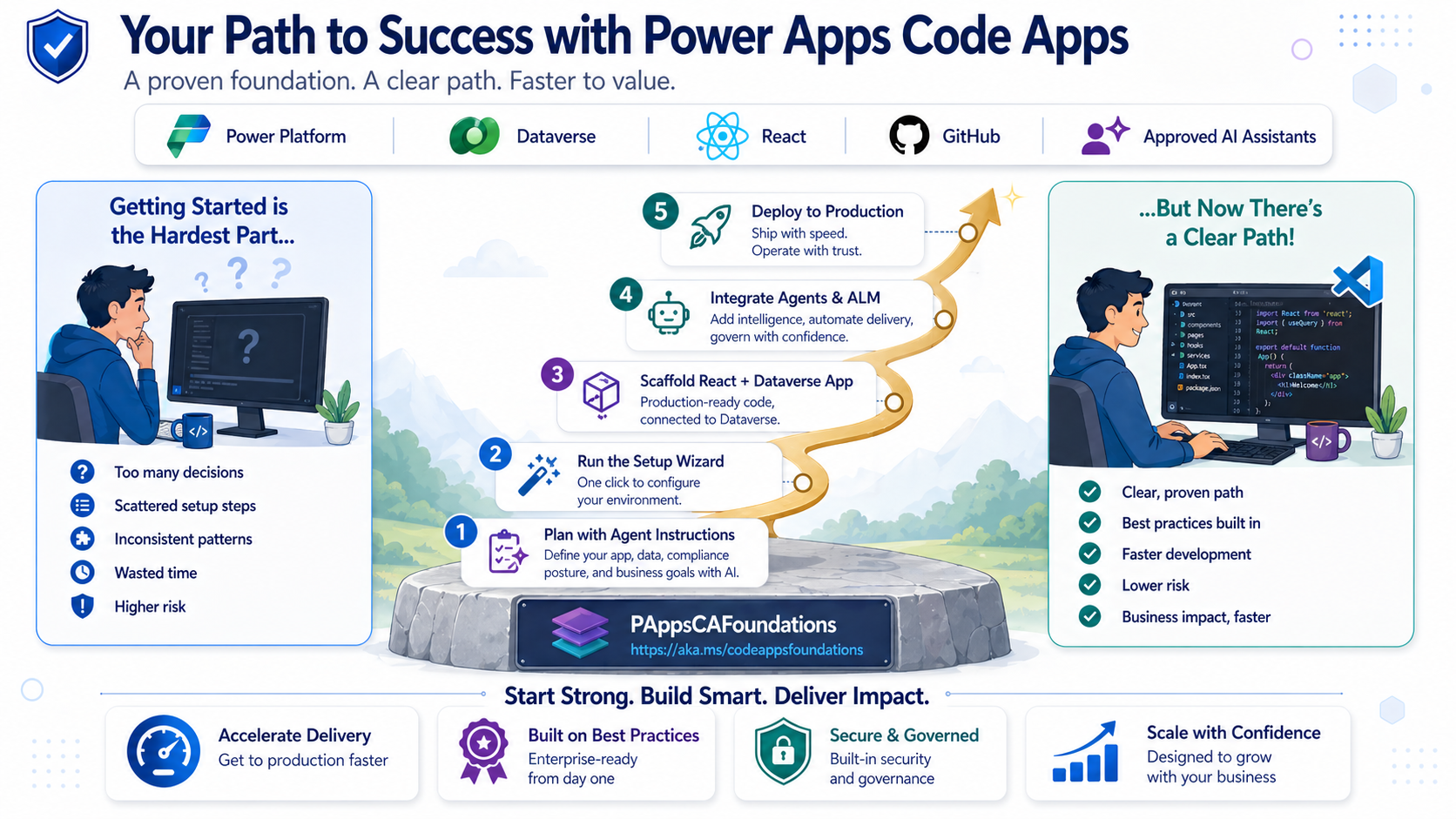
Business decomposition → scope refinement → Dataverse planning → prototype validation → build & deploy. Encoded in your repo.
14 scoped instruction files plus AGENTS.md — Copilot, Cursor, Claude Code, every agent follows the same rules.
A 9-step wizard verifies prerequisites, scaffolds React + Fluent UI + Dataverse, seeds prototype assets, runs smoke tests.
Vitest, Playwright, MSW ship in the scaffold. Smoke tests pass on first run. Mocks let you test before Dataverse exists.
1Password CLI integration or AES-256-GCM encrypted secrets. Pre-commit hooks block accidental secret commits.
Pull the latest instructions, scripts, and wizard into your downstream project. No fork management. No merge conflicts.
Clone the template, run the wizard, start building. Your team gets the accumulated lessons of every team that came before.
Build with AI speed. Govern with enterprise confidence.
"The AI coding tool is just the hammer. The platform is the house."
For organizations that value governance, compliance, agent integration, long-term maintainability, and the ability to scale citizen development safely — especially when PHI is involved — Power Apps Code Apps with Dataverse is the clear, defensible enterprise choice.